
Scott and the small shop: An ode to classic verve and virtue
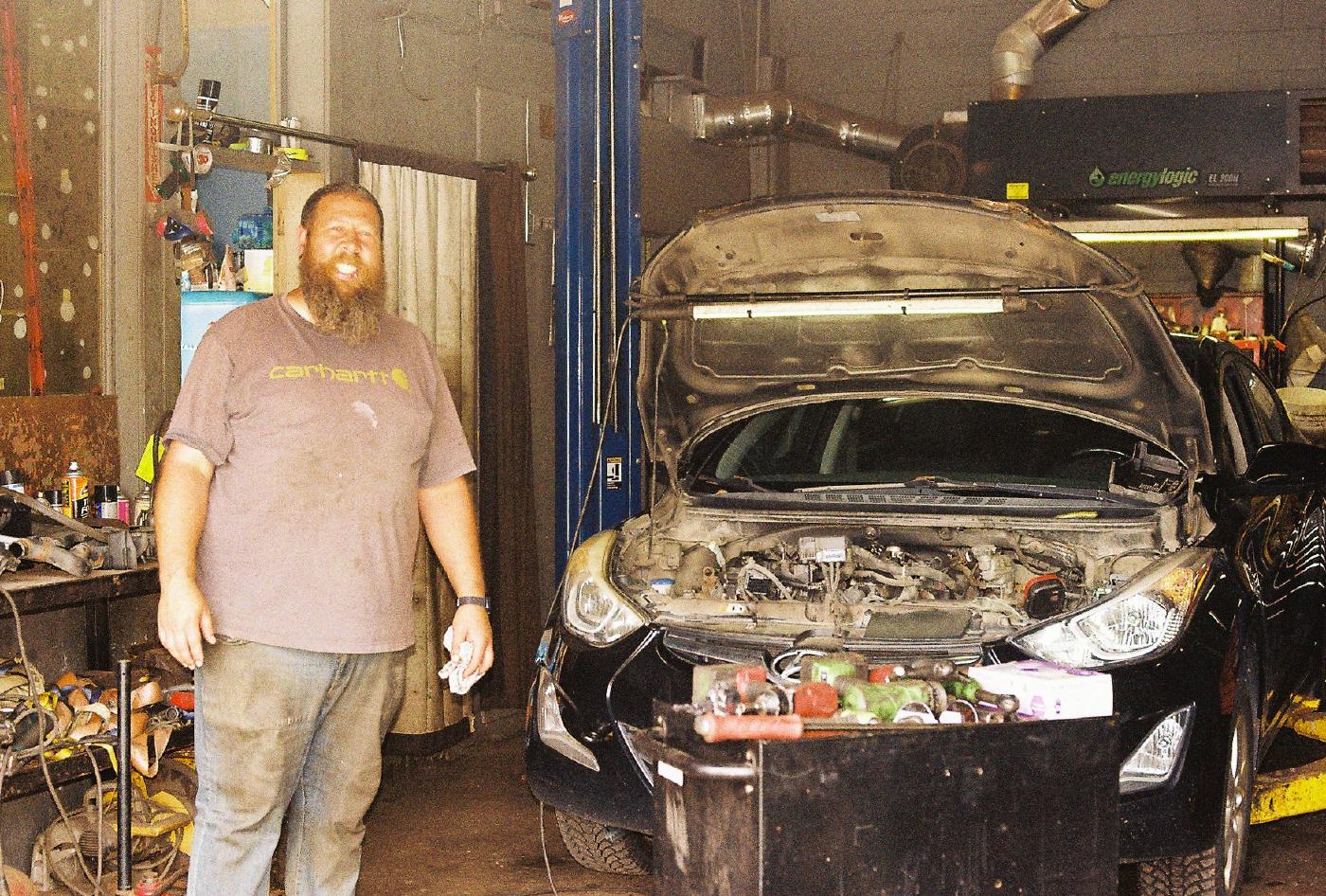
Jerry’s Auto on Pleasant Street in Woodside is regularly open from 8 a.m. to 5 p.m. on weekdays, but if you stroll past the establishment later into the evening, you may notice the lingering shop lights casting warm rectangles onto the outside pavement. You may also hear the clinking and whirring of tools drifting out from the garage door and echoing through the relative silence of late-night Pleasant Street – those lights and living noises are some of my favourite elements of the Woodside ambience.
The rhythmist is usually Scott Rowe, who has worked with Jerry’s Auto for around a decade and is currently their main after-hours mechanic. When I visited him to discuss his life in the trade and his experience at the shop, I carried with me my vision of Jerry’s as an essential facet of my romance with our neighbourhood: the shop is alive with a sort of classic verve that seems to exist less and less in urban areas, and with decreasing confidence everywhere else. The classic verve is hard to define, but I know it when I see it: in open road counterculture movies of the previous century, in small-town diner waitresses, in pictures of my grandfather fishing when he was my age.
It’s not hard for an independent mechanic shop in particular to exude this. Good mechanics need patience, temperance and spirit to survive in their trade. In his 2020 book Why We Drive, philosopher-turned-mechanic Matthew B. Crawford calls this a “conservative disposition,” which he defines as a quality of “not… hankering after the past nor fear of the future, but rather affection for the present.” I saw this in Scott, who seemed carried by an air of contentedness throughout our conversation. It was a sunny Friday afternoon when I popped into the shop. He paused the engine swap job he was working on and wiped his hands with a rag for handshake before we sat down in the shop’s small vestibule.
At first, I was searching for a shared sentimentalism, asking him about his favourite cars, what he loves about his job. He told me he started automotive work in high school.
“You always loved cars?”
“I always liked fixing things,” he corrected me. “Maybe I liked cars, but not anymore.” He laughed.
Scott, in his blue collar hardihood, simply did not share in my romance. He still had his favourites: “I do enjoy a big job,” he told me when I asked about the most rewarding work, “like engine swaps, transmission swaps, stuff like that where it’s fairly intense and long, and feels great when it’s done. But the monotony of oil changes and tire changes… basic maintenance on cars gets repetitive. It’s nice to have stuff that’s more complicated, like diagnostics and wiring issues.” As a former shop service advisor, I was surprised by the latter fact. Electrical work is not the most popular with mechanics. When I brought this up to him he responded: “I get it, it’s complicated if you haven’t done a lot of it,” he shrugged, “if you’re not good at it, you’re not going to get into a lot of it, and you’re not going to get better at it. That’s a problem with dealerships, you know? Whatever you’re good at, that’s all you’re going to get to do.”
While short of sentimentalism, Scott still understood the value of working at Jerry’s. He’d worked for big dealerships in the past and did not prefer their impersonal nature. At Jerry’s, he told me, “say a regular comes in at four o’clock on a Friday with a flat tire, we can do it for them and say, ‘Go enjoy the weekend!’ At the dealer it’s how much are we charging? How much are we going to make off these people?” He told me that working at Jerry’s makes him “part of the community,” that the crew is “a good group together,” and spoke about regulars bringing coffee, beer, lunch, and Christmas cards. Scott isn’t one for platitudes; the tight-knittedness is certain. Boxes of Timbits sit upon the shop’s front desk, thank-you cards hang on the walls next to car calendars and shop-humour signs, and esteemed service advisor Sarah Squires (herself a bastion of skill and patience) has a notedly impressive memory for faces and names.
The shop’s neighbourly feel is part of that aforementioned classic verve – Jerry’s Auto occurs in the real world. Contributing to this feeling, beyond the sense of community, is just the fact of the small, independent shop. Small shops have a decreasing ability to work on newer, more electronic models of cars, separating them from the sense of isolation often incited by new technologies. Expanding on the (de-)evolution of cars is beyond the scope of this piece, but Scott assures me that the rendering obsolete of independent shops is “long down the road” because he observes that “people are struggling to buy new cars… so trying to keep their older cars on the road more, which is exactly where we excel, right?” I nod – they’ve taken good care of my ’04 sedan. Crawford writes about “the homey, nonmagical thingness of a motor,” and elegies that a proper engine “operates without summoning inscrutable entities that are said to live in the Cloud.”
I share this taste with Crawford, and with Jerry’s Auto. Whenever the shop is tasked with work on a cool (old) vehicle, they are sure to park the head-turner where it is visible for the admiring eyes of all passers-by: under the shop sign whose logo is a red ’70s Chevrolet Vega (which, Scott informed me, was the old drag car of Jerry himself).
Between cars, engines, their “thingness” – and the skill, knowledge, and patience required to work on them – I’ve always pedestalized the average mechanic to be carrying some naive sort of Aristotelian virtue – there’s Crawford’s “conservative disposition” or the “gumption” and “quality” of Robert M. Pirsig (author of Zen and the Art of Motorcycle Maintenance). Often it’s one’s naivete or humility towards his own virtue that hammers home its effect upon others. Scott really lit up when talking about his other job – the reason he works flexible hours at Jerry’s: “I groom sports fields for the city… you’re out walking in the fields and getting a tan and, you know, you’re doing it so the kids play sports, right? So, you know, you feel pretty good. I do.
“And then come here and get dirty for a couple hours.”
Here I saw Scott’s affection for the present. He, like many others today, works two jobs for himself and his family. His virtue comes from his contentedness with swapping engines, his excitement with preparing sports fields, and his gratitude for the community that allows a semblance of balance in the chaos of life.
I recently saw a comment online saying: “Don’t get me wrong, early Pleasant St is nice, it’s when you hit Prince Arthur Ave and beyond, it’s ugly.” It’s part of the feeling of the thresholdness in Woodside, a place trapped between past and future. Pleasant Street has long balanced its charm between elder trees, old houses with kept gardens, and train track resonance from behind greasy ma-and-pa eateries. Rising condos are now thrusting into our neighbourhood the modernity of concrete, glass balconies and grey vinyl. But in dwindling pockets of the present, you can see the beauty in an old car engine and the virtue of the people keeping it on the road.