
Sign, sign, everywhere a sign. Part of the scenery, should we pay them any mind?
Some Dartmouth signs offer kind suggestions, others make pointed demands. How do we navigate the thorny issues raised when private interests post official-looking signs around our city?
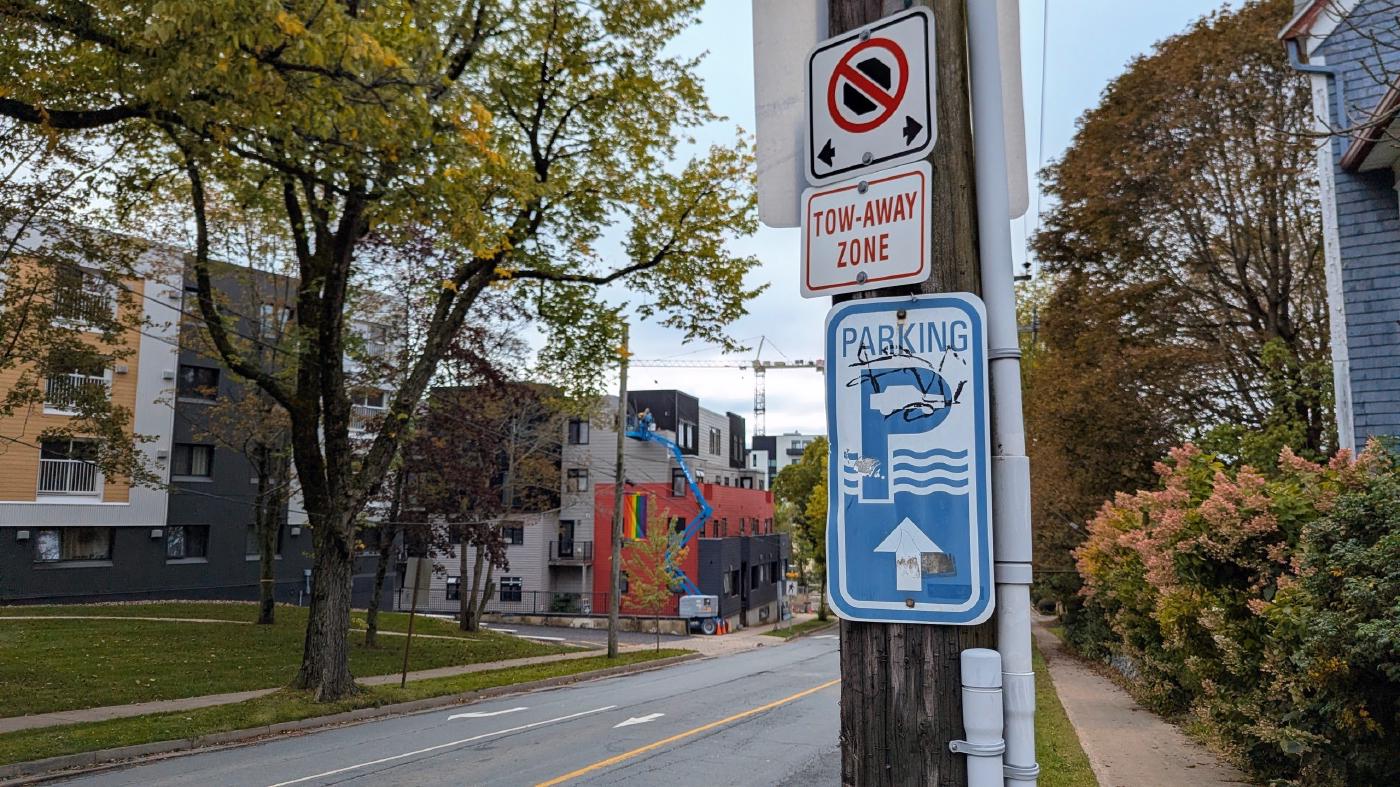
As you walk, bike or drive near downtown Dartmouth, you’re sure to see the mystery sign.
It appears on electrical poles along the roads: small and blue with a big P on it. There is an outline of a car inside the P’s lobe and the capitalized word “PARKING” above that. Behind the P’s stem are wavy blue lines and beneath it are arrows, sometimes pointing left, ahead, right, or in two directions.
Try to follow those arrows. All of them ostensibly point to the downtown core where there is parking on most streets and in several lots. These spots have signs that are green, yellow, red and black, and red and white… but no blue signs.
You could take the approach of Assistant Prof. Michael Faciejew at Dalhousie University’s School of Architecture, who regularly takes his students out to explore urban environments. As an architectural historian, his research focuses on the larger questions of power and mediation in the built environment. When out exploring, he thinks about what the designed elements of an urban landscape might tell us.
“I expand my definition of architecture to include other designed, spatial elements — especially those shaped by engineers and others whose decisions carry design implications,” says Faciejew. “All that for me is within the realm of communication.”
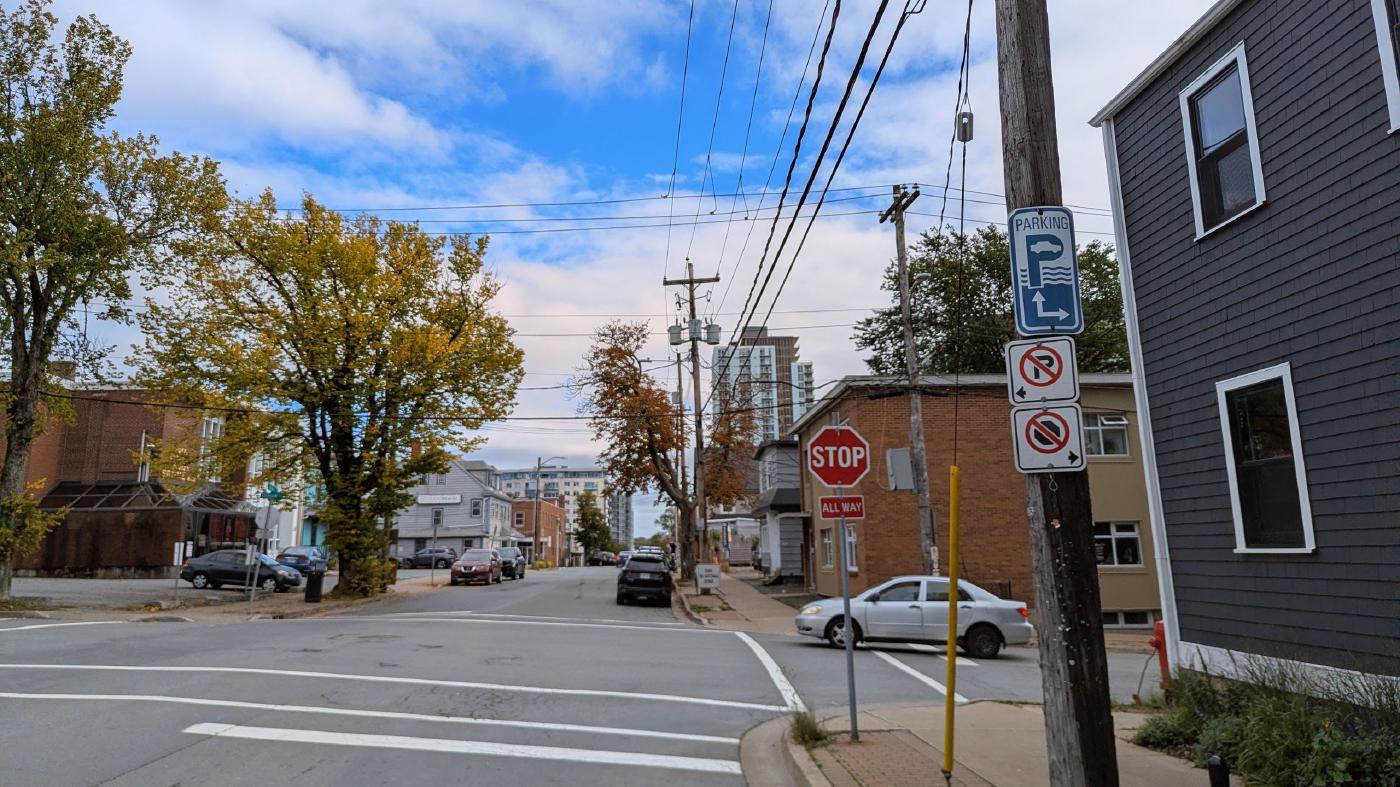
So, what are the signs communicating besides their arrows? They are older, their screws are often rusted, and unlike other road signs they are unreflective. They are often dented and tagged with graffiti or stickers. Their wavy lines are reminiscent of other Dartmouth signs that point in the direction of the Macdonald and MacKay bridges, which themselves resemble Nova Scotia’s scenic travelway shields.
The mystery signs also resemble the travelway signs that dot the province’s highways, from Yarmouth to Cape North. But if you compare them, you note that their wave shapes are shorter than the Tourism Nova Scotia and bridge signs.
“The way you represent yourself establishes how much authority you have,” says Faciejew. In the case of the mystery sign, he thinks it likely that a private property owner adopted the visual language of provincial signage in the hopes of driving more traffic to his or her parking lots.
“Seeing those signs doesn’t make a person think, ‘Oh, this capitalist is trying to increase revenue.’ I think that’s where the sign becomes interesting, because it maybe miscommunicates that public-private balance.”
Can a sign that looks official enough alter public behaviour? That seems to be a perennial question.
Signs of Summer
The tension between public access and private interests has been high in Dartmouth this summer, and signs have played a part in it.
There were the “No Trespassing, Private Property” signs along the Dartmouth Harbourwalk Trail, put up by a company associated with Atlantic Road Construction and Paving Ltd. (ARCP). After the years-long battle between residents and ARCP over the proposed infilling of Dartmouth Cove, Halifax Regional Municipality (HRM) passed a bylaw in October 2025 that restricted infilling the cove. The province has conditionally approved the HRM bylaw, but the issue remains unresolved. The signs appeared that same spring, at both ends of the section owned by ARCP on which there is a registered easement.
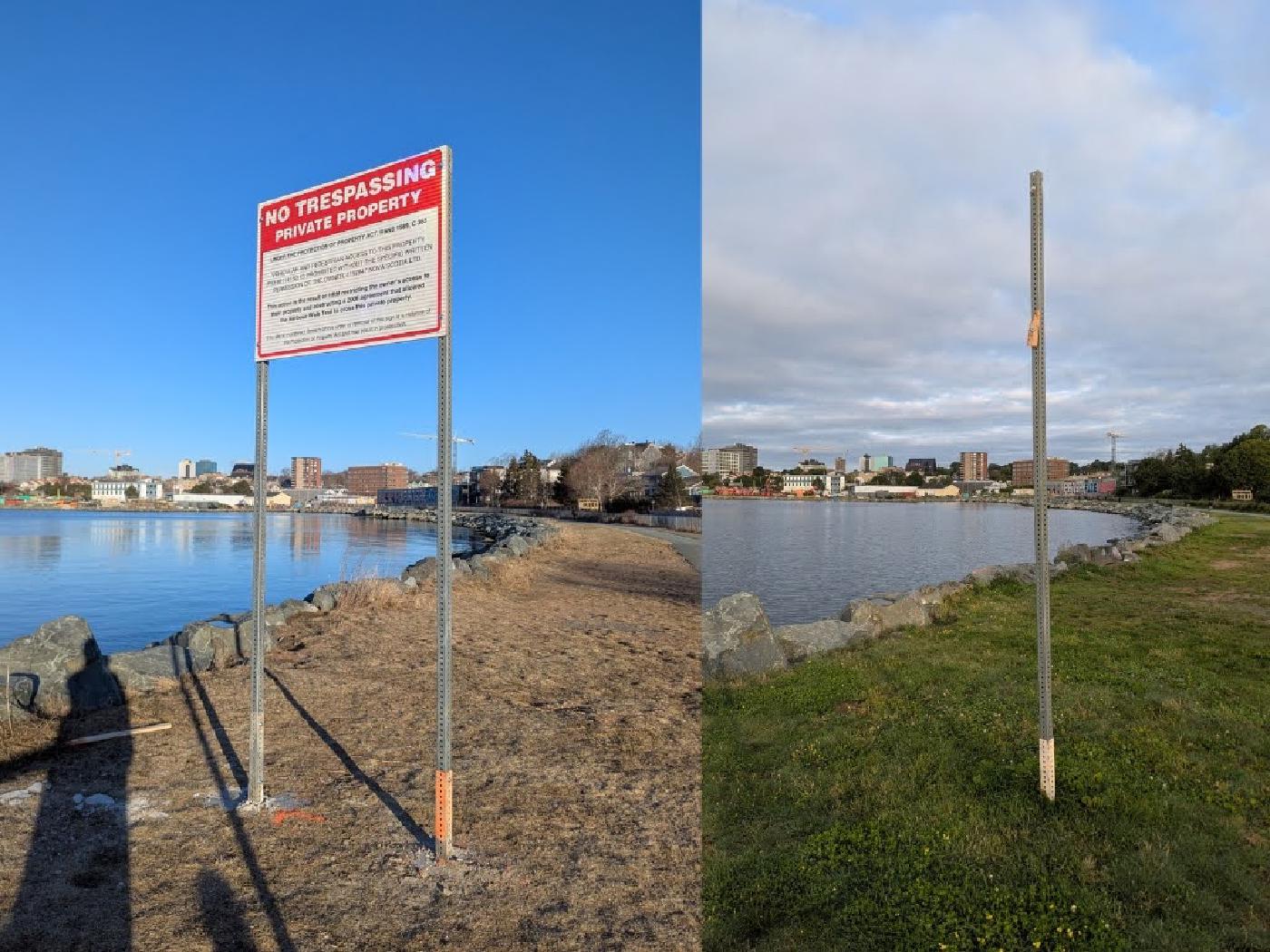
On posts over three metres tall, they projected authority with a citation of the Nova Scotia Property Act and a claim the site was monitored. But, over the next few weeks and months, the signs and their posts were sabotaged and dismantled by unknown persons. The signs ultimately made their way into the cove — floating against the breakwater or sunk — and then removed. By late September 2026 only a single post remains of the two tall signs.
There were also “No Noise” signs attached to other official signposts near the swimming areas of Oat Hill Lake. Annoyed or affected by the sounds of people swimming and playing in the water, someone who lived nearby attached four signs that called for quiet and urged parents to tell their children to “use their indoor voices.” HRM staff ultimately removed the signs from beneath the official HRM sign that asked people to keep it down.
In each case, privately made signs attempted to direct public behaviour. Each sign staked a claim and tried to represent authority it did not actually have.
Both the Dartmouth Cove and the Oat Hill Lake signs were telling people not to do something. Then we have this mysterious blue sign whose visual language is suggesting that you trust its recommendation.
All Signs Point to…
So, what are the mystery signs pointing to?
According to Google Maps, they are leftovers from privately-owned parking lots in downtown Dartmouth, at 57 Portland St., 30 Queen St. and 33 Ochterloney St. Larger wayfinding signs used to greet cars on the side of what is now Morley’s Coffee, across the lot entrance from the parking attendant hut behind Bruno Builders and on the wall of the two-storey lot of Belmont House.
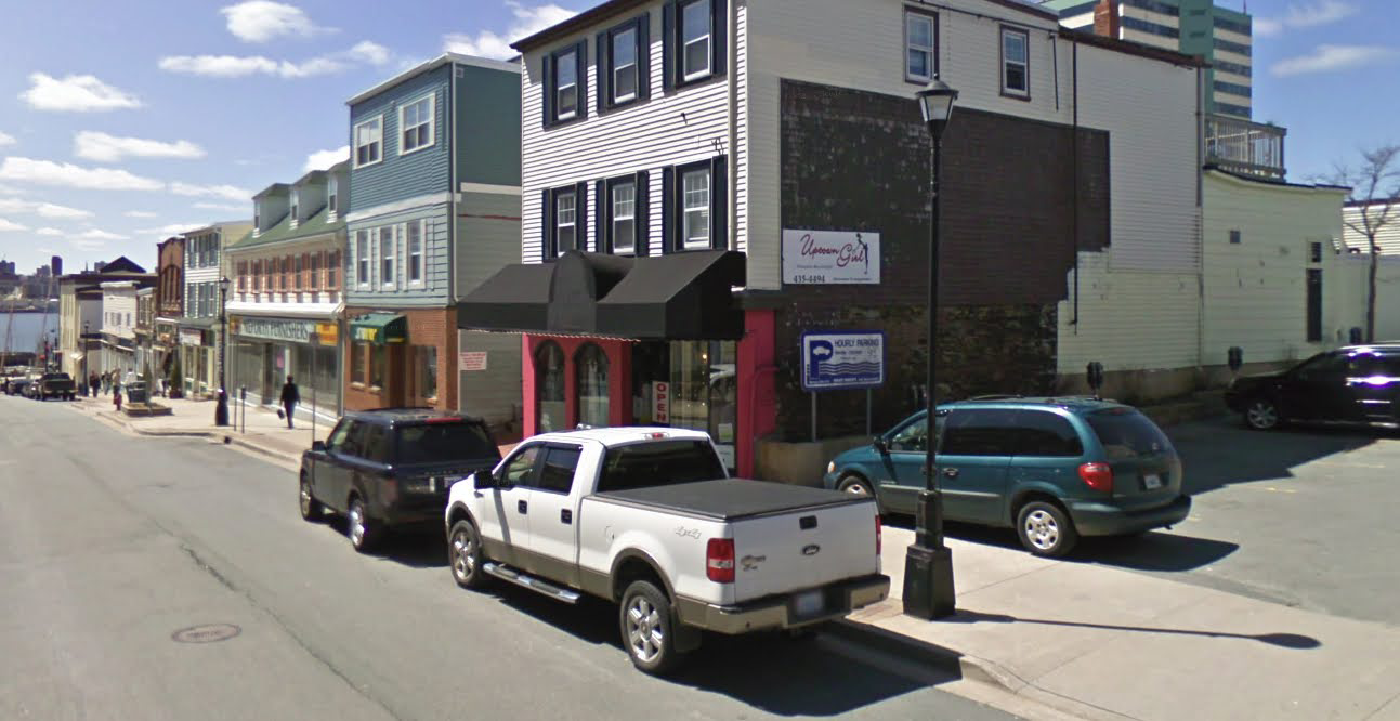
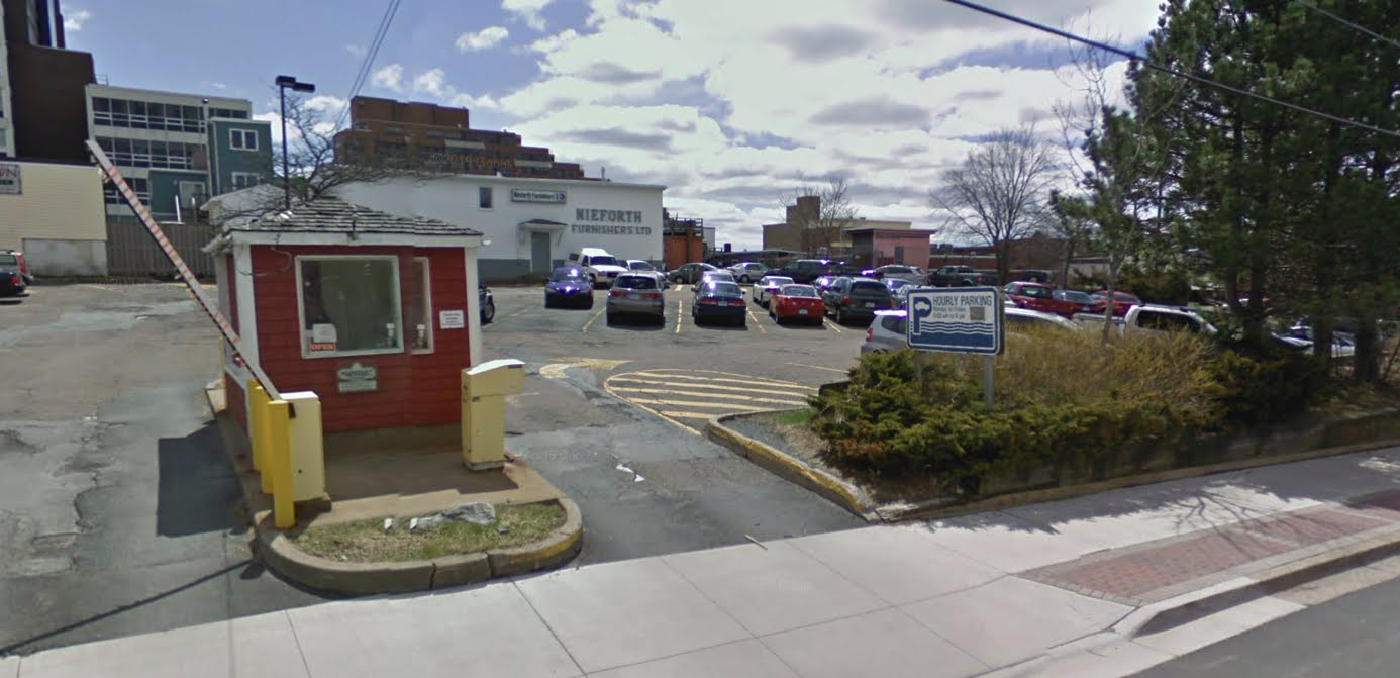
At 30 Queen St., the signs’ old anchors are still there. It would seem the big sign, which had the same blue P with the car shape and waves, simply fell to disrepair. It was replaced at least once, but those post bases were abandoned as well—with the remains of rotten 4-by-4 posts inside. And so, the mystery signs continue to direct us toward only a memory.
For those who still navigate with the help of forgotten waypoints and fallen landmarks — “…turn left where Neighbours used to be, then turn right where the Prince Arthur School was, and continue until you get where the Sobeys used to be — but if you hit the former chocolate factory you’ve gone too far!” — perhaps this works. Either way, the mystery signs seem likely to stay up.
They look like they belong there, anyway.