
Dartmouth homeowner says $14,000 FOI quote deepens confusion over Portland Street plans
A freedom-of-information request tied to HRM’s Dartmouth-Cole Harbour corridor planning study resulted in an estimate that wasn’t so free — thousands in fees for thousands of pages of records — leaving one resident without a clear way to answer her questions or access promised updates.

When Dartmouth resident Judy Baroni filed a freedom-of-information request with the Halifax Regional Municipality seeking records about the Portland Street-Cole Harbour Road Functional Planning Study, she expected to receive documents explaining what was being proposed for her neighbourhood.
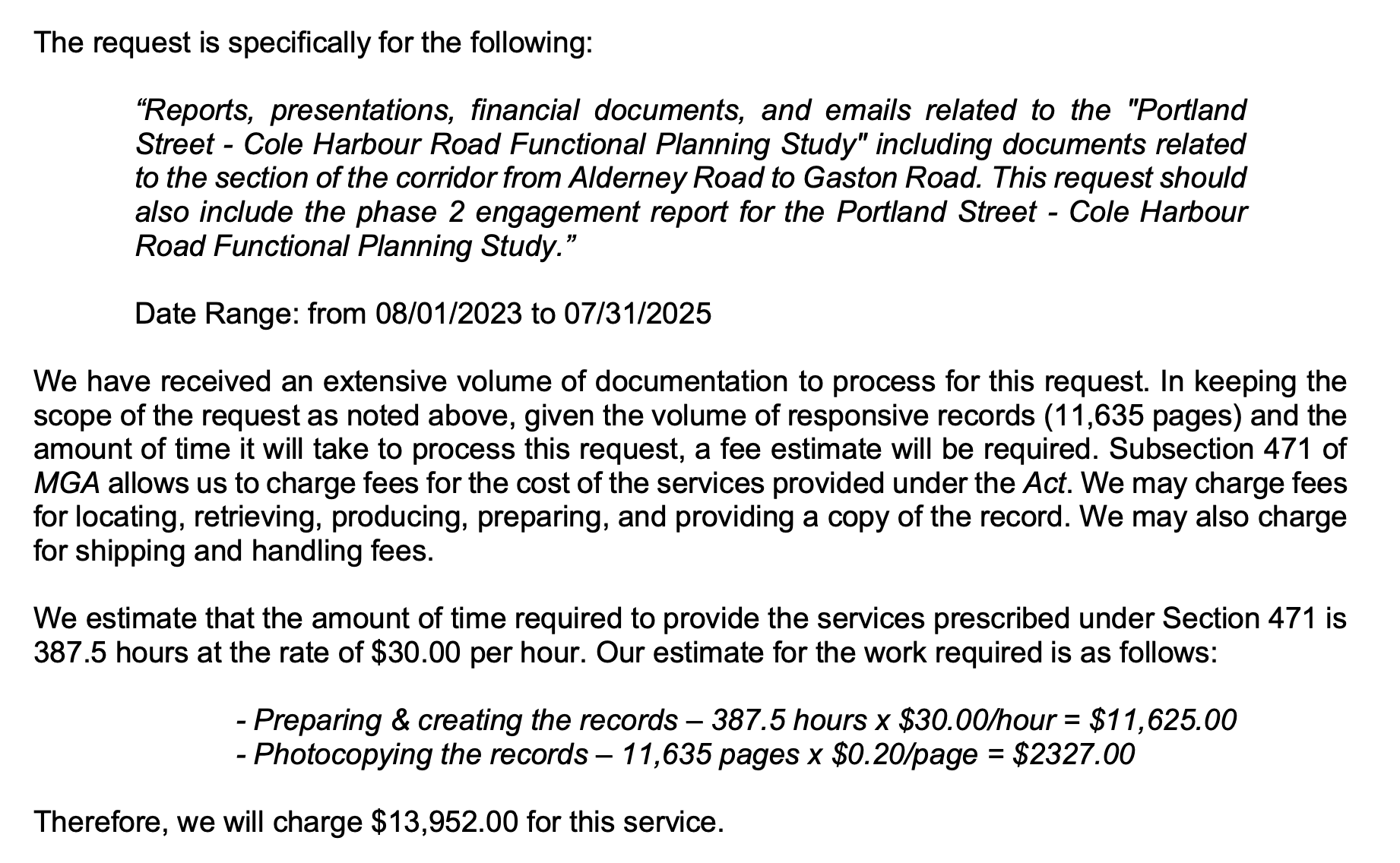
Instead, she received a fee estimate of nearly $14,000.
Baroni said she was shocked.
“If you’ve counted the pages, calculated how much it costs, you’ve already done the work,” she told the Post. “It feels like it’s intentionally trying to keep you from getting anything.”
Baroni has lived on Portland Street since 2002, within the study area of the long-term municipal planning project examining possible changes along the corridor between downtown Dartmouth and Cole Harbour.
The project focuses on potential transit and infrastructure upgrades, including bus lanes, cycling infrastructure, and pedestrian improvements.
Baroni said she first became aware of the project in 2022, when she attended a public consultation. She expected to see plans for the section of Portland Street where she lived — between Five Corners and Gaston Road.
But she said that part of the corridor was notably absent.
When she asked staff about it, she recalled being told the section where she lived had been left out intentionally.
“They said to me, ‘We know that part’s going to be controversial. So we figured it was better not to discuss it until a later date.’”
That later consultation, Baroni said, never came.
A “What We Heard” report promised after early engagement has also yet to be released publicly.
Over time, Baroni began reaching out directly to municipal staff and her councillor, Sam Austin of District 5.
Austin told her the project was still far in the future and unlikely to move quickly — but Baroni said that didn’t address her concern about what was being studied or why.
In an interview with the Post, Austin said the Portland Street-Cole Harbour Road Functional Planning Study remains one of Halifax’s lowest-priority transit projects and that little active work has been taking place in recent years.
“The project is just not a priority right now, which is why there’s nothing to share,” Austin said.
The Post asked Austin for an update on the “What We Heard Report.” He said he has not seen the report and does not know when it will be released publicly.
For Baroni, however, that explanation did not resolve her concerns.
“I’m asking why [are] staff still spending money on this if they haven’t talked to anybody who lives here,” she said.
Eventually, she filed her first Freedom of Information and Protection of Privacy request under Nova Scotia’s FOIPOP legislation.
According to documents and correspondence shared by Baroni, the municipality initially estimated the cost of fulfilling her request at nearly $14,000, after staff identified more than 11,000 pages of potentially relevant records.
After narrowing the scope, the estimate dropped to roughly $5,000, with more than 4,000 pages still considered relevant.
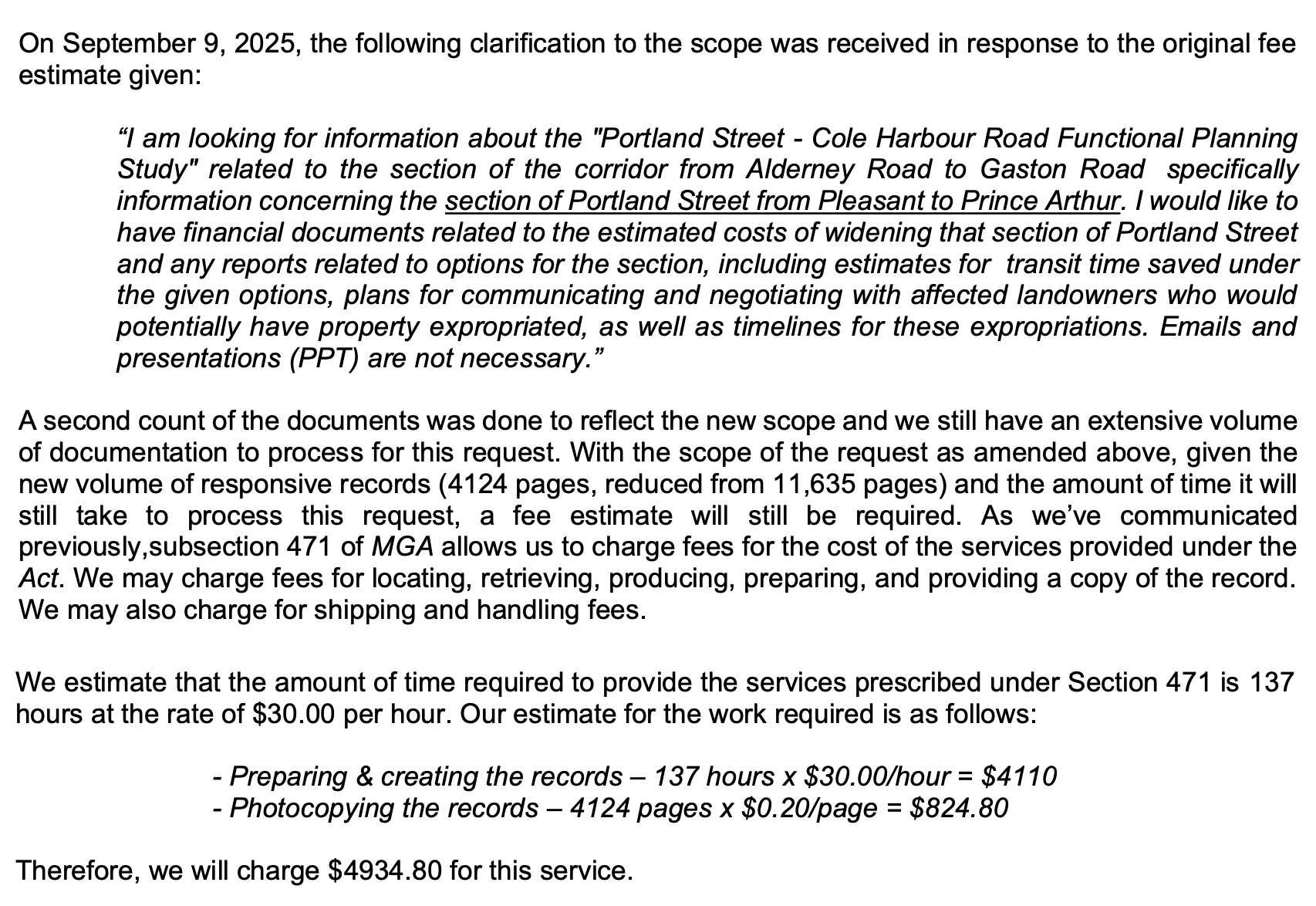
Even at its lowest point, she said the cost remained around $2,000 — still out of reach for most individuals seeking public information.
In a written response to the Post, HRM spokesperson Graeme Benjamin said FOIPOP fees are calculated under Nova Scotia legislation and can include the time required to locate, retrieve, review, and prepare records for release.
“Costs are dependent on the scope of the request and the volume of responsive records identified,” Benjamin said. “Requests involving large volumes of records or complex reviews may require significantly more staff time to process.”
Benjamin said applicants can reduce costs by narrowing the scope of their request. Residents can also contact the municipality’s Access to Information team for guidance or appeal fee estimates to the Nova Scotia Office of Information and Privacy Commissioner.
Yet, Baroni said the experience became increasingly confusing as she tried to refine her request and understand what records actually existed.
“I talked about maybe doing a bit of a GoFundMe,” she said. “But [. . .] at this point, I feel like I wasn’t even sure what I was asking for anymore.”
For Baroni, the challenge was not simply the cost of obtaining records, but navigating the process itself.
Nova Scotia’s FOIPOP system is designed to give residents access to government records, typically within 30 days. Baroni said that timeline was not met in her case, and follow-ups often went unanswered.
“I actually had to call and be like, ‘I sent you a FOIPOP two weeks ago,’” she said.
She believes the current provincial system places too much burden on requesters to narrow their own searches without sufficient guidance.
“It would be great to have maybe more of a guide to talk about language and restrictions,” Baroni said.
Baroni said the experience has left her frustrated not only with the planning process itself, but with how difficult it can be for residents to access information about projects affecting their communities. She said the lack of updates – and difficulty accessing records – has undermined her trust in the process.
“It just didn’t inspire a lot of confidence in the system,” Baroni said.
Even now, she said she is unsure whether she would attempt another FOIPOP request.
“I feel like I’ve been spun around in circles a lot,” she said. “I don’t really know what else to do.”
The Portland Street-Cole Harbour study is one of several long-range transportation and mobility projects underway in the HRM — projects that often involve years of technical planning, consultation, and public feedback.
But for Baroni, the issue is not necessarily opposition to the project itself.
“I’m not de facto against this plan,” she said. “I literally want more information.”
Austin acknowledged that the municipality may have created confusion by launching consultations on a project that was years away from being implemented.
“I think there is fault in terms of going out to people, raising expectations about something,” Austin said. “But then it’s so far on the back burner that then people are left wondering where that is.”
He said residents have been left waiting for answers not because decisions are being made behind closed doors, but because the project has remained largely dormant while other transit priorities move ahead.